
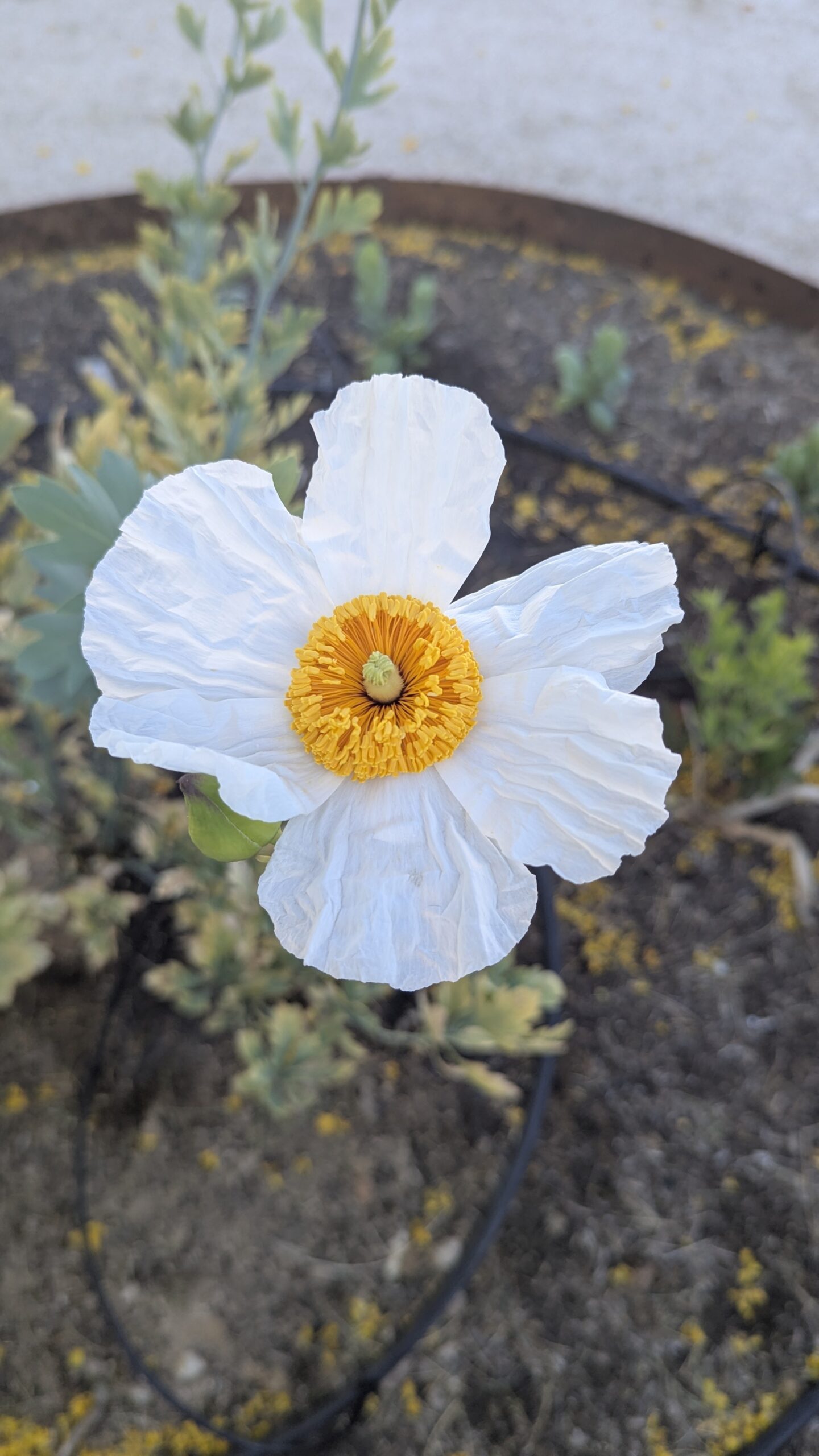
There are plants you appreciate, and then there are plants that stop you dead in your tracks. For me, the Matilija poppy was the latter.
I was visiting a friend’s yard when I spotted it — this enormous, sprawling shrub well over six feet tall, absolutely covered in blooms. The flowers looked like something out of a dream: oversized, tissue-paper-thin white petals surrounding a bright golden center, swaying gently in the breeze. Right then and there, I knew I had to have one.
So, What Exactly Is a Matilija Poppy?
If you’ve never encountered one, let me introduce you to Romneya coulteri — commonly called the Matilija poppy (pronounced mah-TEE-lee-hah) and nicknamed the “fried egg flower” for obvious reasons.
Native to Southern California and Baja California, the Matilija poppy is one of the most dramatic plants you can grow in a high desert garden. It’s a perennial shrub that can reach six to eight feet tall — sometimes even taller — and spreads generously once it’s established. Those iconic blooms? They’re the largest flowers of any native wildflower on the North American continent, sometimes reaching five to nine inches across.
And here’s the best part for us desert gardeners: it’s incredibly drought tolerant. Once established, it thrives on neglect, preferring lean, well-drained soil and minimal water. It’s exactly the kind of bold, water-wise plant that belongs in a high desert garden.

The Search (and the Wait)
After seeing my friend’s plant, I started searching for a Matilija poppy of my own almost immediately — and quickly discovered they’re not exactly easy to track down. Not every nursery carries them, and when they do, they don’t always have them in stock.
But there was another obstacle: I didn’t even have a place to plant one yet. My front yard redesign was still in progress, and I knew this plant needed room — real room — to do its thing. So I had to be patient and wait until the redesign was complete before I could even think about planting.
That waiting period turned out to be a good thing, because it gave me time to actually learn about what I was getting into.
What I Learned Before Planting
Going in, I knew next to nothing about Matilija poppies. So I did my research, and one of the most helpful things I learned came from a Southern California plant nursery: the best time to plant California native flowers is November. Planting in fall gives natives a chance to establish their roots during the cooler, wetter months before summer heat arrives — setting them up for much better success.
A few other things I picked up along the way:
- They don’t love rich soil. Matilija poppies actually prefer lean, well-drained, even rocky soil. Amending with compost or fertilizing can do more harm than good.
- They spread. This is a plant that will naturalize and send up new shoots from its roots. Give it space and plan for it to grow outward over time.
- Less water is more. Once established, they need very little supplemental irrigation — overwatering is one of the fastest ways to lose one.
- They can be slow to establish. Patience is part of the deal with this plant.
Planting Day and My First Spring
Then spring arrived — and it bloomed.
When I finally got my Matilija poppy in the ground, it felt like a long time coming. I’d been thinking about this plant for months, and there was something really satisfying about watching it go from a small nursery container into its new permanent home in my front yard.
I genuinely wasn’t expecting flowers in the first season. Everything I’d read suggested Matilija poppies can take a year or two before they really perform. So when I walked outside one morning and spotted those crepe-paper blooms opening up, I may have done a little happy dance.

What I’m Still Learning
I’ll be honest: I’m still very much in the early stages with this plant. I’m learning as I go, and I’m sure there will be plenty of trial and error ahead. A few things I’m keeping in mind as I move forward:
- Pruning after bloom: Once the flowers fade, cutting the plant back encourages fresh growth and keeps it from getting too woody.
- Let it naturalize: The spreading habit can feel alarming at first, but it’s part of the plant’s character. Work with it, not against it.
- Don’t fuss too much: This plant doesn’t want a lot of attention. The best thing I can do is stay out of its way and let it do what it does.
I’ll be sharing updates as the seasons change and this beauty continues to grow and fill in. If you’ve grown a Matilija poppy — or you’re thinking about adding one to your garden — I’d love to hear from you. Drop your tips, questions, or stories in the comments below! 👇
Looking for more water-wise plants for your high desert garden? Browse the blog for more native plant inspiration and desert gardening guides.