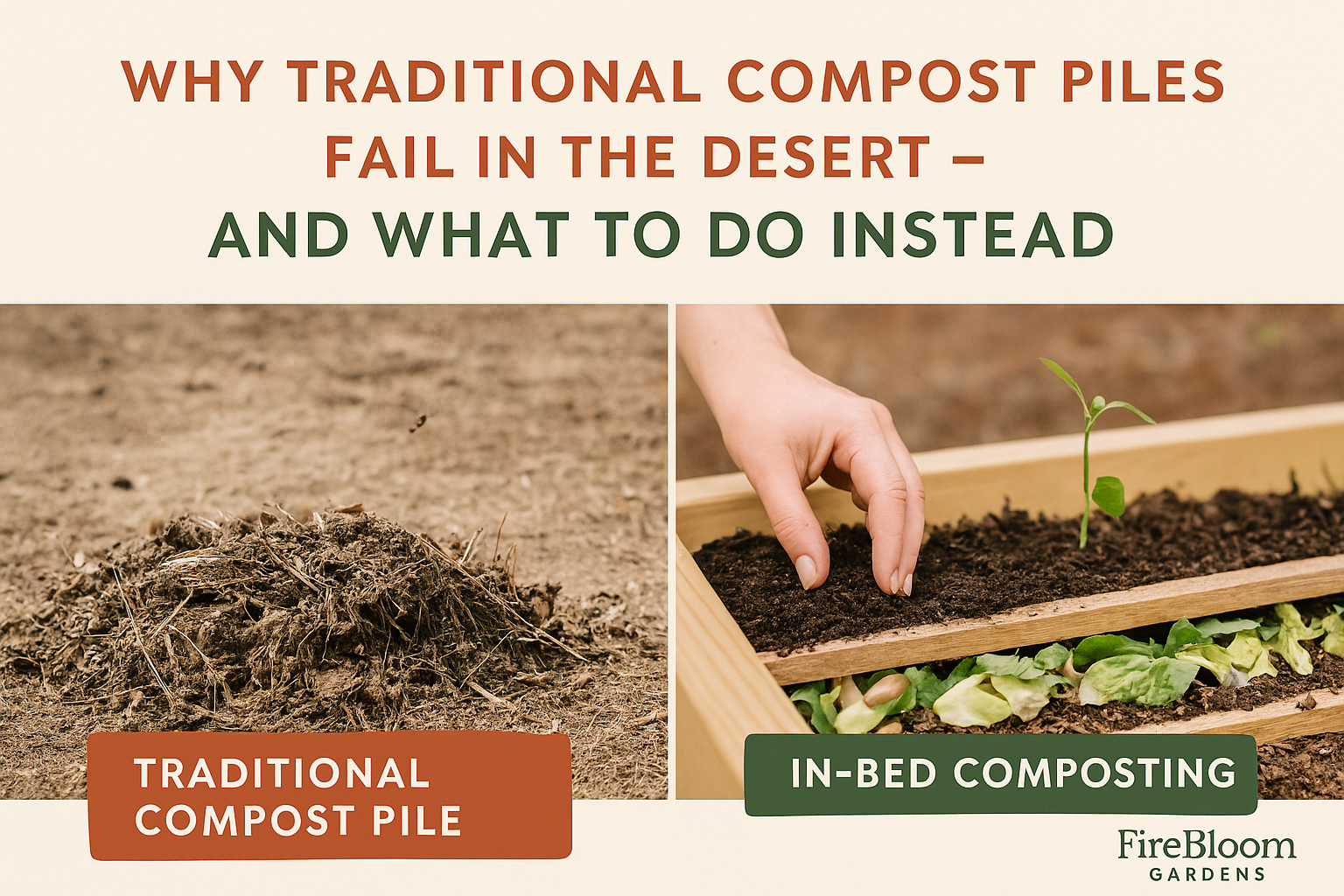
Why Traditional Compost Piles Fail in the Desert – And What to Do Instead
Still trying to compost like you live in Seattle? That pile doesn’t stand a chance in the desert.
If you’ve ever watched your compost pile dry up faster than last summer’s birdbath, you’re not alone. Traditional composting methods, designed for cool, damp climates, simply don’t survive the relentless sun, dry winds, and parched soil of the desert. To make composting work here, you need more than good intentions—you need a climate-smart strategy.
The Harsh Reality of Desert Composting
Composting might be second nature in lush, coastal climates—but try that same method in the high desert, and you’re likely to end up with a pile of dried-out disappointment. That’s because most traditional composting advice was built for places where rain falls regularly, humidity hangs in the air, and the sun doesn’t cook the ground by 10 a.m. In arid environments, composting becomes a battle against evaporation, heat, and neglect. Here’s why your pile might be failing before it even starts.
Rapid Moisture Loss
Water is the lifeblood of compost, and desert climates steal it fast. Compost needs 40–60% moisture—about the feel of a wrung-out sponge—to support the microbial life that drives decomposition.
Your compost turns into a stale cracker before it even has the chance to ferment.
Heat and Sun Exposure
In cooler climates, the sun is your compost pile’s best friend. In the desert, it’s more like a blowtorch. Direct sunlight cooks the pile, kills beneficial microbes, and speeds up water loss.
A sun-baked pile can dry out in a single afternoon—especially if it’s exposed and uncovered.
Imagine trying to ferment yogurt in a cast-iron pan in the middle of summer—it curdles, not composts.
Improper Pile Maintenance
Turning the pile adds oxygen, which is essential. But in the desert, each turn also exposes more surface area to the air, drying the pile even faster if you’re not replacing that lost moisture.
“Turning too often without re-wetting the pile can make drying worse.” — [Life Management Science Labs]
It’s like flipping pancakes in a desert windstorm –each flip loses more of what little moisture you had.
Poor Pile Size & Structure
Too small? The pile can’t hold heat or moisture. Too big? It goes anaerobic and smells like a swamp. Getting the right structure is tricky—and critical—in extreme climates.
Compost piles under 3x3x3 feet dry out too quickly, and over 5x5x5 feet struggle with airflow.
Think Goldilocks in the desert—too small and it crisps, too big and it stews.
Compost Lasagna
Inadequate Covering or Shade
Leaving a pile exposed to the elements in the desert is like sunbathing without sunscreen—it’s going to burn. Uncovered compost loses moisture fast to wind, heat, and solar radiation.
“Shade and cover are key to slowing moisture loss in arid zones.” — [University of Arizona Extension]
Your compost is basically camping in Death Valley with no tent and no water.
The Science of What’s Really Going Wrong
It’s easy to blame the sun or dry air when your compost refuses to break down—but the real issue lies in what’s happening inside the pile. Composting is a biological process, and at the heart of it all are microorganisms: bacteria, fungi, and tiny decomposers that thrive in specific conditions.
For these living agents to stay active and do their job, your pile needs to maintain a moisture content of 40–60%—that’s about as wet as a wrung-out sponge. In the desert, though, evaporation works faster than hydration. Without regular watering and shade, your pile becomes too dry for microbial life to survive. Once they check out, so does your decomposition.
Think of your compost like sourdough starter—it needs the right balance of warmth and hydration to stay alive. Dry it out, and it becomes a flaky, lifeless crust. So if you’re not feeding your pile water like you’d feed starter with flour, don’t expect much rise.
Desert-Proof Solutions That Actually Work
So, your compost pile’s gone crispy. Don’t worry—composting in the desert isn’t impossible, it just requires a little adaptation. Once you understand what’s sabotaging your pile, you can take smart steps to keep your compost moist, active, and alive—even under a brutal sun. Here’s how to do it right in arid climates:
Choose the Right Method
If your compost pile keeps drying out, it might be time to ditch the traditional open-air heap. Desert gardeners have better options. I personally use the Vermicomposting method.
Compost Trenches: Dig a shallow trench between rows or under trees, fill with organic matter, and bury. The soil naturally insulates and retains moisture.
In-Bed Composting: Let your garden do double duty. Bury scraps right in your planting beds and let worms and microbes work underground.
Worm Bins (Vermicompost): Worms love a controlled environment. A shaded, enclosed worm bin can thrive where open piles fail.
Enclosed Systems: Tumblers, barrels, or DIY lidded bins trap moisture and protect from sun and wind.
Think of it as composting undercover. Less exposure, more success.
Shade It or Cover It
Evaporation is your biggest enemy—shade is your best defense.
DIY Shade Hack: Use shade cloth, old patio umbrellas, or a wooden pallet leaned up to create cover.
Best Locations: Tuck your pile along a north-facing wall, under a large desert tree, or next to a shed that casts afternoon shadow.
Cover the Pile: A tarp, scrap of cardboard, or even a layer of straw helps trap moisture and reduce water loss.
If you wouldn’t sit there in August, your compost probably shouldn’t either.
Water Like You Mean It
Desert composting means being intentional with moisture.
How to Check: Grab a handful and squeeze. It should feel like a damp sponge—moist but not dripping.
When to Add: Check moisture every few days, especially after turning or wind events.
How to Add: Use a watering can, hose with a shower nozzle, or set up a drip emitter that waters slowly over time.
Water Sources: Repurpose gray water from rinsing veggies, capture rainwater, or save the runoff from your swamp cooler (if you have one).
In the desert, you’re not just watering plants—you’re hydrating your microbes.
Rethink Turning
Turning helps with oxygen, but in dry climates, it’s easy to overdo it.
Rule of Thumb: Only turn if the pile is moist and breaking down.
Smart Turning: Turn only the core, leave the edges alone to act as insulation.
Timing: Early morning or after watering = less evaporation.
Think gentle massage, not a full flip.
Size Matters
Your compost pile needs to be big enough to retain heat and moisture—but not so big that it suffocates.
Ideal Size: Aim for a pile that’s at least 3x3x3 feet—big enough to insulate itself, small enough to breathe.
Layer Like a Pro: Alternate wet (greens) and dry (browns) materials. Top each layer with a splash of water.
Bonus Tip: Add a layer of straw or shredded cardboard to help seal in moisture between turns.
Think of it like a compost lasagna: balanced, layered, and juicy.
Quick Reference: Your Desert Composting Checklist
Need a no-fluff reminder you can pin to your garden wall or save to your phone? Here’s your desert composting cheat sheet—designed for dry climates and busy hands. Screenshot it, print it, tape it to your watering can. Your microbes will thank you.
Place in Shade Tuck your compost near a north-facing wall, under a tree, or behind a structure to protect it from scorching sun.
Cover with Tarp or Lid Keep moisture in and sun/wind out. A tarp, old shower curtain, or even a layer of straw does the trick.
Monitor Moisture Weekly Grab, squeeze, and feel. Like a damp sponge = good. Like a dry granola bar = bad.
Use Trench or In-Bed Methods Composting underground or in garden beds keeps moisture trapped and microbes happy.
Limit Turning Turn only when needed and only if the pile is still moist. Less flipping = less drying.
Water Deeply but Less Often Soak the pile thoroughly instead of misting. Early morning or evening is best.
Resources & Further Reading
Curious to dig deeper? These expert resources break down the science and solutions behind composting in arid environments. Whether you’re troubleshooting a stubborn pile or looking to fine-tune your method, these reads have your back:
If your compost pile keeps turning into a crispy heap of regrets, it’s time to stop composting like you live in Portland. The desert demands a different rhythm—and now you know how to work with it, not against it. From trenching scraps to shading bins, every adaptation helps your pile stay moist, active, and alive.
Leave a comment below and let me know what’s the biggest composting struggle you’ve faced in the desert? Let’s troubleshoot it together.